Our Articles
Square and Rectangular UN Containers vs Round Plastic Drums
How Much Fits on a Pallet
By Daniel Hartmann ·
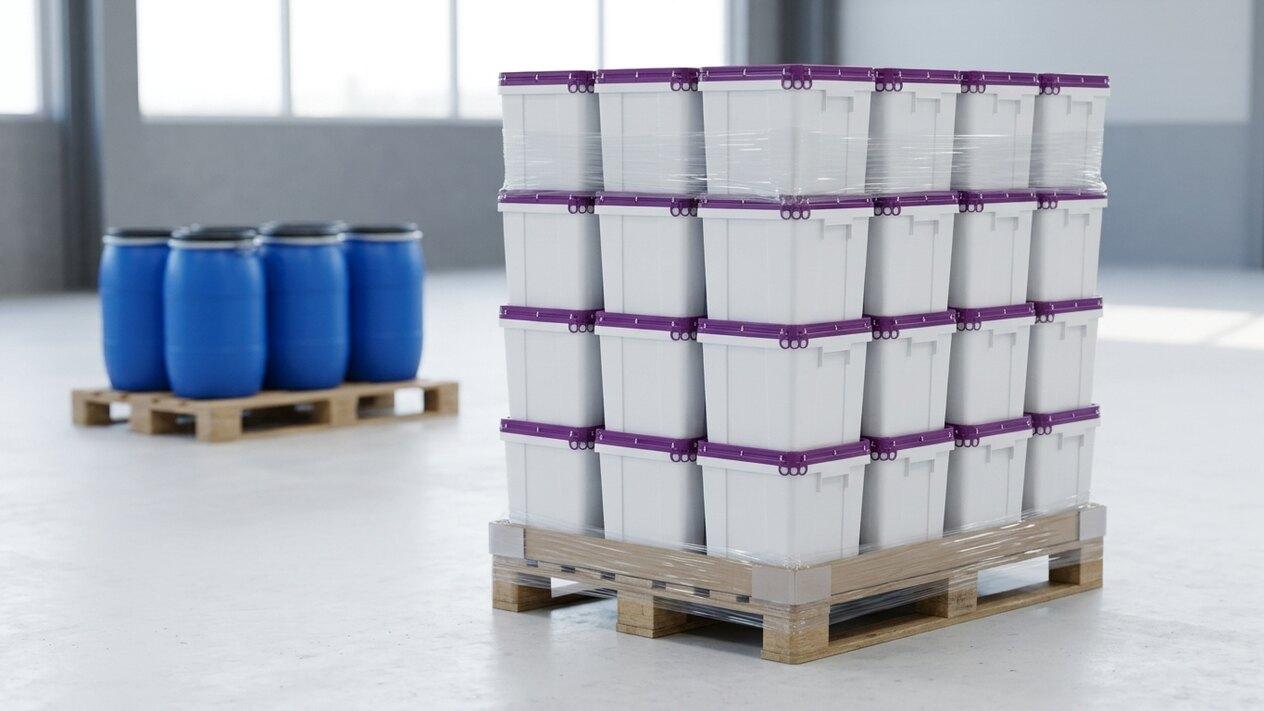
Across a 20-pallet shipment in a 40-foot high-cube refrigerated container, the illustrated Darbox configuration can carry 18 tonnes of product versus 9 tonnes in conventional PE drums, subject to the specified loading and stacking conditions.
Darbox specializes in nestable industrial packaging for pharmaceutical APIs, fine chemicals, powders and other bulk solids. This article examines how container geometry, pallet utilization and empty-container nesting can improve packaging and transport efficiency.
Why Container Shape Matters in Industrial Packaging
Every pallet occupies a defined amount of space in a warehouse, truck or shipping container. Container dimensions determine how efficiently that space can be used.
A circular footprint occupies approximately 78.5% of its enclosing square, based on the geometric ratio π ÷ 4. Conventional round drums arranged in straight rows therefore leave unused space between their circular footprints.
Staggered arrangements can reduce this loss, but the overall packing efficiency still depends on drum diameter and pallet dimensions.
Square and rectangular containers can make more efficient use of pallet space when their external dimensions are coordinated with standard pallet formats.
Darbox SquarePack containers with a 378 × 378 mm footprint allow nine containers to be arranged in a 3 × 3 pattern on a 1140 × 1140 mm pallet. This arrangement covers approximately 99% of the pallet surface.
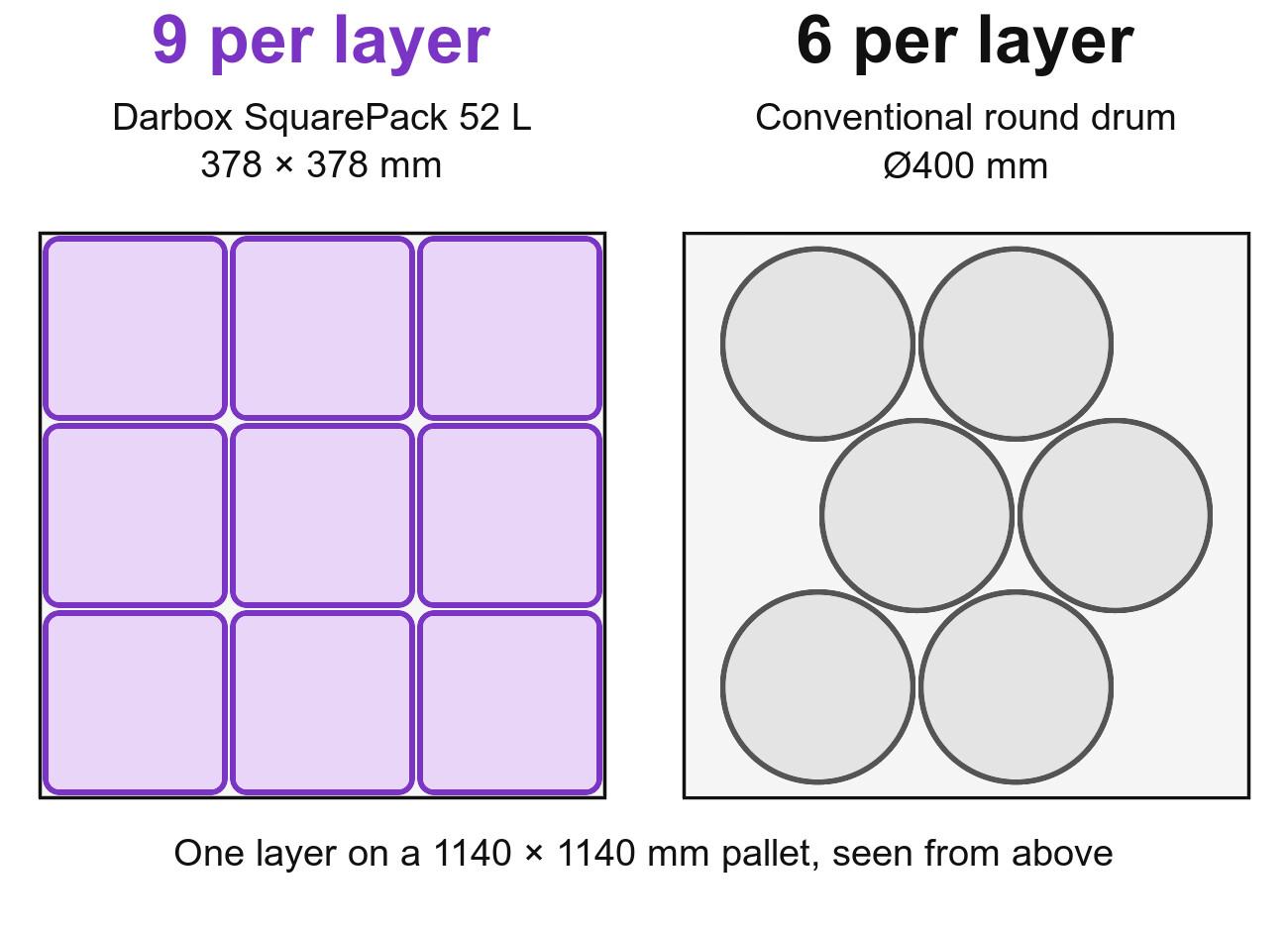
The result is efficient utilization of the pallet footprint, supporting higher quantities of product per layer where the filling weight is comparable.
Pallet Comparison: Darbox SquarePack vs Conventional Round Drums
Comparing industrial packaging requires considering the external dimensions of each container and the amount of product carried.
The following example compares the Darbox SquarePack 52 L with two conventional industrial packaging formats:
- Blue PE open-head drum: 50 L, Ø400 × 610 mm.
- Fiber drum: 60 L, maximum external diameter 415 mm, height 519 mm.
The Darbox SquarePack 52 L has external dimensions of 378 × 378 × 470 mm, with a nominal capacity of approximately 51.8 L under the lid.
Comparison on a 1140 × 1140 mm Pallet
| Packaging format | External dimensions | Containers per layer | Product per layer at 25 kg/container |
|---|---|---|---|
| Darbox SquarePack 52 L | 378 × 378 × 470 mm | 9 | 225 kg |
| Conventional blue PE drum, 50 L | Ø400 × 610 mm | 6 | 150 kg |
| Conventional fiber drum, 60 L | Ø415 × 519 mm | 6 | 150 kg |
At the same filling weight of 25 kg per container, the Darbox SquarePack configuration carries 75 kg more product per pallet layer, representing a 50% increase.
The compact square footprint also allows the containers to occupy nearly the entire pallet surface.
The comparison uses confirmed geometric pallet arrangements and a common net filling weight. Final loaded-pallet configurations must also meet the applicable stacking and transport requirements.
One Pallet Layer, Size by Size
Darbox SquarePack and QuadPack containers use square and rectangular footprints designed to improve pallet-space utilization compared with conventional cylindrical industrial drums.
The following comparisons use external dimensions from published Darbox specifications and representative PE and fiber drum specifications.
| Darbox container | Conventional packaging alternative | Pallet size | Darbox units per layer | Conventional units per layer |
|---|---|---|---|---|
| SquarePack 52 L | Blue PE drum, 50 L, Ø400 mm | 1140 × 1140 mm | 9 | 6 |
| SquarePack 52 L | Fiber drum, 60 L, Ø415 mm | 1140 × 1140 mm | 9 | 6 |
| QuadPack 114 L | Blue PE drum, 120 L, Ø496 mm | 1200 × 1000 mm | 5 | 4 |
For the SquarePack 52 L examples, the square arrangement provides 50% more container positions per layer.
For the QuadPack 114 L example, the rectangular arrangement provides 25% more container positions per layer.
These differences demonstrate how exterior packaging dimensions influence pallet capacity. Actual product throughput depends on the net filling weight permitted for the selected packaging.
Rectangular Packaging: Darbox QuadPack 114 L
The Darbox QuadPack 114 L applies the same pallet-efficiency design principles used in the SquarePack range to a larger rectangular format.
Its rectangular footprint of 598 × 397 mm allows five containers to fit in one layer on a 1200 × 1000 mm pallet using a mixed-orientation arrangement.
The QuadPack 114 L has a nominal capacity of 112.1 L under the lid and carries the UN 4H2/Y50/S marking for solid dangerous goods.
Its open-top construction, full-size lid and integral tamper-evident tear-off band provide a practical packaging solution for powders and industrial solids.
The combination of efficient pallet geometry and UN-approved construction makes the QuadPack 114 L suitable for consideration when replacing conventional large-diameter industrial drums.
Empty Containers: How Nesting Improves Inbound Logistics
Transporting and storing empty packaging can account for a significant part of industrial packaging logistics.
Conventional straight-sided blue PE drums and rigid fiber drums are generally transported as individual, full-size containers. Because their bodies are not designed to nest inside one another, the empty packaging occupies substantial transport and warehouse space.
Darbox SquarePack and QuadPack containers have tapered bodies designed to nest compactly when empty.
This allows multiple empty container bodies to be packed together, reducing the space required for inbound transport and storage compared with conventional non-nestable drums.
One pallet carries the following numbers of empty, nested container bodies:
| Darbox container | Empty bodies per pallet | Pallet size | Height added by each nested body |
|---|---|---|---|
| SquarePack 35 L | 180 | 1140 × 1140 mm | 90 mm |
| SquarePack 52 L | 144 | 1140 × 1140 mm | 104.5 mm |
| SquarePack 70 L | 108 | 1140 × 1140 mm | 130 mm |
| QuadPack 114 L | 50 | 1200 × 1000 mm | 151 mm |
An empty SquarePack 52 L body is 470 mm high and adds 104.5 mm to a nested stack.
Darbox supplies empty container bodies nested, with compatible lids packed separately in stacks on separate pallets.
For companies purchasing large annual quantities of industrial packaging, reducing the volume of empty packaging can improve inbound freight efficiency, warehouse utilization and material handling.
The actual logistics benefit depends on shipment quantities, the existing packaging format and the transport configuration.
A Worked Example: Shipping 10 Tonnes of Powder
Consider a manufacturer shipping 10 tonnes of powder with a bulk density of 0.6 kg/L.
At a net filling weight of 25 kg, each container requires approximately 41.7 L of capacity. A shipment of 10 tonnes therefore requires 400 containers.
On a 1140 × 1140 mm pallet, the comparison is:
| Parameter | Darbox SquarePack 52 L | Conventional blue PE drum, 50 L |
|---|---|---|
| Filling weight per container | 25 kg | 25 kg |
| Total containers | 400 | 400 |
| Containers per layer | 9 | 6 |
| Layer equivalents | 45 | 67 |
The SquarePack arrangement requires 22 fewer theoretical layer equivalents to accommodate the same product quantity.
This reduction demonstrates the advantage of efficient pallet geometry before the number of permitted stacked layers is considered.
From Pallet Layers to Actual Shipments
The advantages of square packaging become more significant when comparing complete shipments rather than individual pallet layers.
Using Darbox SquarePack 52 L containers and conventional 50 L blue PE drums, both filled with 25 kg of product, the difference in pallet utilization can result in substantially higher product quantities per shipment.
40-Foot High-Cube Refrigerated Container
The following comparison illustrates the shipping capacity of Darbox SquarePack 52 L containers versus conventional 50 L PE drums, based on a shipment configuration of 20 CP3 pallets (1140 × 1140 mm).
| Parameter | Darbox SquarePack 52 L | Conventional 50 L PE drum |
|---|---|---|
| Containers per pallet layer | 9 | 6 |
| Filled layers per pallet | 4 | 3 |
| Containers per pallet | 36 | 18 |
| Net product per shipment | 18,000 kg | 9,000 kg |
Result: The Darbox configuration offers 100% more product capacity per shipment, an additional 9 tonnes under the illustrated conditions.
The difference in layers comes from height. Four layers of SquarePack 52 L containers are 1,880 mm high. Three layers of the 610 mm drums are 1,830 mm high, and a fourth layer would bring them to 2,440 mm.
The comparison assumes the stated loading arrangement is permitted by the applicable UN packaging stacking requirements and the actual refrigerated-container configuration.
Standard European Semi-Trailer
The following comparison is based on a shipment configuration of 22 CP3 pallets, with four filled layers per pallet for both packaging formats.
| Parameter | Darbox SquarePack 52 L | Conventional 50 L PE drum |
|---|---|---|
| Containers per pallet layer | 9 | 6 |
| Filled layers per pallet | 4 | 4 |
| Containers per pallet | 36 | 24 |
| Net product per shipment | 19,800 kg | 13,200 kg |
Result: The Darbox configuration carries 6.6 additional tonnes of product per shipment, representing 50% more product under the illustrated conditions.
Both comparisons are subject to the applicable stacking approval, vehicle payload and actual loading configuration.
Darbox can evaluate a customer's existing packaging, filling weight and shipment requirements to establish the appropriate palletization and transport arrangement.
Beyond Pallet Space: Operational Advantages of Darbox Containers
Efficient pallet utilization is one component of industrial packaging performance. Darbox SquarePack and QuadPack containers are also designed to support practical handling, secure closing and compact inbound logistics.
Open-Top Filling and Discharge
The full-size openings allow access for filling and emptying powders, granules and other industrial solids.
Appropriate inner liners can be supplied when required by the product or process.
Tamper-Evident Lids
Selected Darbox SquarePack and QuadPack containers incorporate integral tear-off tamper-evident bands.
After removing the band, the lid can be opened and reclosed. However, the packaging is no longer UN-approved in that opened configuration.
UN 4H2 Packaging
Darbox offers UN 4H2-approved rigid plastic packaging for solid dangerous goods in selected square and rectangular formats.
These include the SquarePack range and QuadPack 114 L, which carries the UN 4H2/Y50/S marking.
Packaging selection must take account of the material's UN number, packing group, packing instruction and the relevant packaging approval.
Efficient Empty Packaging Logistics
Tapered bodies allow empty Darbox containers to nest compactly during transport and storage.
This reduces the space required for empty container bodies compared with conventional non-nestable industrial drums.
Industrial Materials and Construction
Darbox uses HDPE and PP materials according to the specific product design.
The containers are intended for industrial applications including pharmaceutical APIs, fine chemicals and other solid products that require robust secondary packaging.
What You Need to Compare Cost per Tonne Shipped
The purchase price of the empty container is only one component of the total packaging cost.
A meaningful packaging comparison should consider the entire logistics process, from the delivery of empty packaging to the shipment of filled product.
Key parameters include:
- Net filling weight per container
- Filled containers per pallet
- Permitted stacking configuration
- Pallets per truck or shipping container
- Empty packaging transport requirements
- Warehouse space required for empty and filled packaging
- Packaging tare weight
- Filling and handling costs
- Applicable reuse, disposal and recycling requirements
Darbox can compare its square and rectangular packaging solutions against a customer's existing PE drums, fiber drums or other industrial packaging.
The objective is to establish whether a change in packaging format can improve pallet utilization and reduce the overall cost per net tonne shipped.
Method and Assumptions
The comparisons in this article are based on published external packaging dimensions and the pallet arrangements confirmed by Darbox.
The following principles apply:
- Darbox dimensions are taken from the applicable product specifications.
- Conventional drum dimensions are taken from published supplier specifications.
- All containers are positioned upright without pallet overhang.
- Square and rectangular arrangements use the external dimensions of the containers.
- Round-container arrangements use the external drum diameter, including the relevant widest external dimension.
- Product-weight comparisons use the same net filling weight per container.
- Empty-container nesting is evaluated separately from filled-container stacking.
- The refrigerated-container example assumes 20 CP3 pallets per shipment.
- The semi-trailer example assumes 22 CP3 pallets per shipment.
- Actual shipment quantities depend on the available transport equipment, stacking approval and payload limits.
Geometric pallet utilization is a useful starting point for packaging selection. Final transport efficiency is determined by the complete packaging and logistics configuration.
Frequently asked questions
Do square containers nest as well as round ones?
Darbox SquarePack containers are tapered and specifically designed to nest when empty. Unlike conventional straight-sided PE drums and rigid fiber drums that retain their external dimensions during empty transport, SquarePack bodies can be packed inside one another, reducing the space required for inbound packaging logistics. The actual savings depend on the quantities shipped and the customer's existing packaging configuration.
Which pallet size suits SquarePack containers best?
A 1140 × 1140 mm pallet provides particularly efficient utilization for Darbox SquarePack containers with a 378 × 378 mm footprint. Nine containers fit in a 3 × 3 arrangement, covering approximately 99% of the pallet surface. Six containers fit per layer on 1200 × 800 mm and 1200 × 1000 mm pallets. The best pallet configuration for filled containers also depends on filling weight, stacking requirements and the transport method.
Are square containers as strong as round ones when stacked?
Square containers can be engineered and tested for demanding industrial stacking conditions, just as conventional round drums can. The actual stacking performance depends on the approved packaging design, net filling weight, lid construction and handling conditions. Darbox offers UN 4H2-approved SquarePack containers for solid dangerous goods. To evaluate the correct container and stacking arrangement, Darbox reviews the customer's product characteristics, filling weight, pallet dimensions and transport requirements. Contact Darbox at sales@darbox.com with your packaging requirements to receive a product-specific assessment.
Is a rectangular drum the same as a rectangular container?
Not necessarily. The terms may overlap in commercial usage, but the packaging construction and UN classification determine its regulatory designation. Darbox QuadPack 114 L is an open-top rectangular plastic container carrying the UN 4H2/Y50/S marking for solids. The QuadPack 114 L is designed according to the same pallet-efficiency principles as Darbox square containers. Its rectangular footprint allows efficient utilization of pallet space, while its full-size lid provides practical access for filling and emptying industrial solids.
Can I get a pallet plan for my product?
Yes. Darbox can prepare a product-specific packaging and palletization proposal using your current packaging dimensions, product bulk density, filling weight, pallet format and annual volume. The assessment can include filled-container arrangements, UN packaging requirements and the transport configuration, including 40-foot refrigerated containers where applicable. Contact sales@darbox.com with your requirements to evaluate the appropriate packaging and palletization solution.