Our Articles
Tamper-Evident Plastic Containers for Bulk APIs and Pharmaceutical Powders
What to Check Before You Choose
By Daniel Hartmann ·
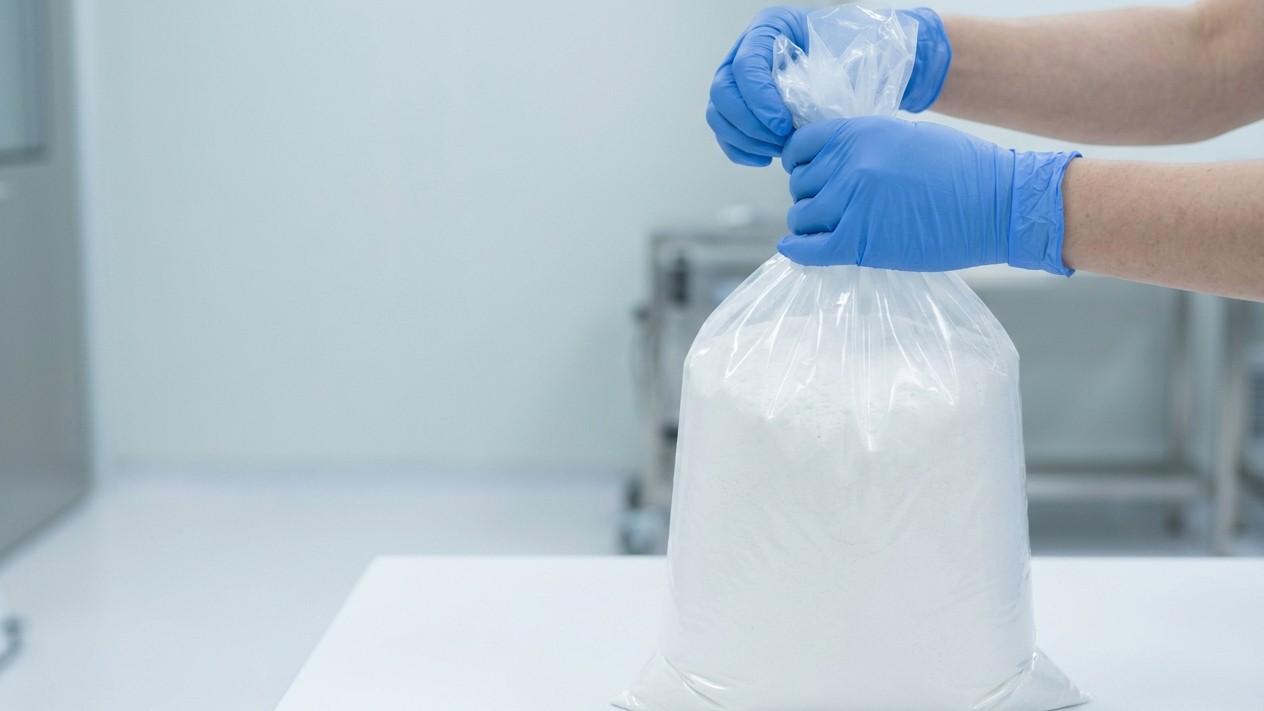
In pharmaceutical manufacturing, packaging plays an important role in protecting valuable materials throughout the supply chain.
Active pharmaceutical ingredients (APIs), intermediates and excipients often travel through several stages of filling, storage, transportation and handling before reaching their final destination. Each stage requires packaging that combines reliable mechanical protection, secure lids and efficient handling.
When pharmaceutical powders are packed in qualified inner liners, the surrounding rigid container serves as secondary packaging. Its role is to protect the packed material, support safe handling, provide tamper evidence and optimize storage and transportation.
With over 65 years of industrial packaging experience, Darbox develops and manufactures heavy-duty, nestable plastic containers for pharmaceutical, chemical and other demanding industrial applications.
The Darbox portfolio includes square, rectangular and round packaging solutions ranging from 12 to 114 L, manufactured from virgin plastic materials approved for food contact.
Darbox products are designed as mono-material plastic packaging solutions, supporting material recovery and recycling where suitable infrastructure is available.
Seven sizes carry a UN 4H2 mark for dangerous solids as standard, from the SquarePack 22 L to the QuadPack 114 L. Three more have it as an option.
What a Container for APIs Has to Do
Selecting secondary packaging for APIs and pharmaceutical powders involves more than choosing the correct volume.
ICH Q7 emphasizes the importance of protecting pharmaceutical materials from deterioration and contamination. When an API is enclosed in a qualified inner liner, the rigid outer container contributes to the overall protection and handling performance of the packaging system.
A suitable secondary container should address four essential requirements:
- Minimize external contamination risks. Darbox containers feature all-plastic construction without paper-based walls or metal clamp rings. This avoids potential sources of fibre or metal contamination associated with certain traditional packaging formats.
- Provide visible tamper evidence. On eight sizes, Darbox lids feature an integrated tear-off band that provides a clear visual indication of whether the original lid has been opened. As long as the band remains intact, the original tamper-evident feature has not been broken.
- Improve pallet efficiency. The larger SquarePack models share a 378 × 378 mm footprint, so nine containers cover 99% of a 1140 × 1140 mm pallet layer.
- Reduce space requirements before filling. Their tapered construction allows empty containers to nest inside one another. For example, a single pallet can accommodate 180 empty SquarePack 35 L container bodies.
The rigid plastic construction also provides practical benefits over fibre-based secondary packaging.
HDPE and PP do not absorb moisture. Paper-based materials do. This can be particularly relevant where pharmaceutical powders are packaged inside heat-sealed PE liners.
However, moisture protection must always be assessed for the complete packaging system, including the liner, container, lid and storage conditions.
Secondary Packaging with an Inner Liner
For APIs, pharmaceutical intermediates and excipients, the primary product-contact layer is typically a qualified inner bag or liner.
The inner liner is selected and qualified according to the pharmaceutical manufacturer's requirements, while the Darbox container serves as rigid secondary packaging.
This separation of functions provides several advantages.
The liner is responsible for direct product contact and, depending on its specifications, may provide additional protection against moisture or other environmental conditions.
The Darbox container provides external mechanical protection, secure lid fastening, stackability, tamper evidence and efficient logistics. Where required, an approved UN packaging configuration can also support the transportation of dangerous solids.
Darbox can supply compatible inner bags, liners and complementary packaging products according to customer requirements.
Darbox supplies PE inner bags and heat-sealed liners. Material specifications, dimensions, thickness and other requirements are determined in accordance with the customer's packaging needs.
Filling and Packaging Process
Darbox containers are supplied with the empty container bodies nested inside one another, while the lids are stacked separately. Container bodies and lids are shipped on separate pallets to maximize transportation and storage efficiency.
During filling, the customer places the qualified inner liner inside the rigid container, fills and seals the liner according to the approved process, and then secures the Darbox lid.
For SquarePack and QuadPack models equipped with press-on lids, the lid is secured without a separate metal clamp ring or special closing tool.
This simple packaging process supports efficient handling while reducing the storage space required for empty containers.
Which Darbox Container Fits Which Use
The most suitable container depends on the weight and bulk density of the material, the dimensions of the inner liner, handling requirements and any applicable dangerous-goods classification.
Pharmaceutical powders with identical net weights may require significantly different container capacities because their bulk densities vary.
For example:
| Net product weight | Bulk density | Required product volume |
|---|---|---|
| 25 kg | 1.0 kg/L | 25 L |
| 25 kg | 0.7 kg/L | 35.7 L |
| 25 kg | 0.5 kg/L | 50 L |
| 25 kg | 0.4 kg/L | 62.5 L |
These are theoretical material volumes. Actual selection must also account for liner dimensions, filling headspace, the container's capacity and handling requirements.
SquarePack, QuadPack, SnapPack and SuperPack offer different capacity and lid configurations for pharmaceutical secondary packaging.
The following sections describe typical application possibilities.
High-Value APIs in Small Batches
For smaller quantities of high-value APIs, the SquarePack 16, 22, 25 and 35 L models provide compact, rigid secondary packaging solutions.
Their square footprint supports efficient palletization, while their integral handles improve handling and positioning.
These models incorporate tamper-evident press-on lids, allowing the recipient to identify whether the original lid has been opened.
The SquarePack 22, 25 and 35 L models are available with UN 4H2-certified configurations, while the 16 L model has an optional UN configuration.
For pharmaceutical applications, the product remains enclosed in a qualified inner liner.
Bulk APIs, Intermediates and Excipients
For larger quantities of pharmaceutical powders, the SquarePack 45, 52 and 70 L models offer additional capacity while maintaining a common square footprint.
Their HDPE bodies, PP lids and integrated tamper-evident bands provide a practical alternative to traditional fibre drums with separate metal closing rings.
The SquarePack 45 and 52 L models can be considered for 25 kg liner-bag applications, subject to the product's actual volume and the inner liner's dimensions.
For lower-density materials, the larger SquarePack 70 L offers a nominal capacity of 70 L.
Darbox also offers the rectangular QuadPack 114 L, providing a nominal capacity of 114 L.
Its rectangular footprint is designed for efficient pallet utilization, while the heavy-duty construction and integrated tamper-evident lid support demanding industrial applications.
The QuadPack 114 L is available with UN 4H2/Y50/S certification for solids.
Tablets and Capsules in Process
Not every pharmaceutical application requires a permanently tamper-evident lid.
For internal material movement, temporary storage and repeated access, a reclosable container is more practical.
The Darbox SnapPack 52 and 75 L models feature a four-snap lid system that allows repeated opening and closing.
The round SuperPack family, from 26 to 53 L, uses twist-on lids with a child-resistant locking mechanism.
Both product families offer provisions for fitting a security seal, providing an additional means of identifying unauthorized opening.
These containers serve as rigid secondary packaging for qualified inner bags containing tablets, capsules, granules or other solid pharmaceutical materials.
Samples, R&D and Pilot Batches
Smaller quantities used in research, development and pilot production may benefit from compact secondary packaging.
Darbox offers the SquarePack 12 L, SquarePack 16 L, and the round TwistPack 16 and 20 L models.
With capacities from 12 to 20 L, they take smaller liner bags.
The appropriate container and lid should be selected according to the intended use, packaging specifications and transport classification.
Tamper Evidence Built Into the Lid
Tamper evidence is an important consideration when transporting valuable pharmaceutical materials.
Eight Darbox container models feature an integrated tear-off band built directly into the lid:
- SquarePack 16 L
- SquarePack 22 L
- SquarePack 25 L
- SquarePack 35 L
- SquarePack 45 L
- SquarePack 52 L
- SquarePack 70 L
- QuadPack 114 L
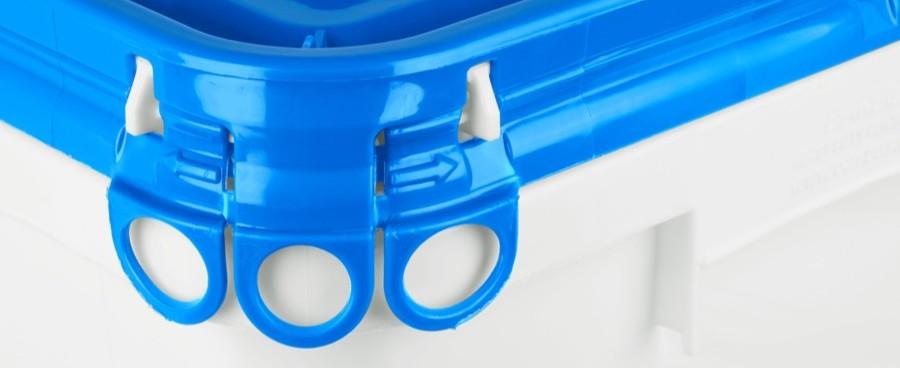
The tear-off band forms part of the original lid.
Before the container can be opened normally, the band must be removed. Once removed, it cannot be restored to its original condition.
This provides visible evidence that the original lid has been opened.
Reopening and Reusing the Lid
The SquarePack and QuadPack lids remain functional after the integrated tear-off band has been removed, allowing the container to be opened and reclosed as needed.
For additional use, customers can also purchase new, intact replacement lids separately.
A new lid restores the original tamper-evident feature, provided that the replacement lid is compatible with the container.
However, once the original tear-off band has been removed, the packaging no longer retains its UN certification in that opened configuration.
For any subsequent shipment requiring UN approval, the container and replacement lid must meet the applicable certified packaging configuration and reuse requirements. Installing a new lid alone does not automatically establish renewed UN compliance.
Other Darbox models provide provisions for additional security seals, depending on their specific lid design.
Dangerous APIs and UN Marks
Certain APIs, pharmaceutical intermediates and related chemical substances are classified as dangerous goods under applicable transportation regulations.
For these materials, the outer packaging must meet the relevant dangerous-goods requirements.
Darbox offers UN-certified plastic containers under the 4H2 packaging classification.
The 4H2 code identifies a plastic box packaging design approved for specified dangerous-goods applications.
The exact marking and permitted gross mass vary according to the tested packaging configuration.
| Product line | Capacity | UN marking |
|---|---|---|
| SquarePack | 12 L | Optional 4H2/Y15/S |
| SquarePack | 16 L | Optional 4H2/Y18/S |
| SquarePack | 21 L | Optional 4H2/Y25/S |
| SquarePack | 22 L | 4H2/Y25/S |
| SquarePack | 25 L | 4H2/Y25/S |
| SquarePack | 35 L | 4H2/Y30/S |
| SquarePack | 45 L | 4H2/Y50/S |
| SquarePack | 52 L | 4H2/Y55/S |
| SquarePack | 70 L | 4H2/Y60/S and 4H2/X25/S |
| QuadPack | 114 L | 4H2/Y50/S |
Understanding UN 4H2
The UN marking provides information about the packaging design and its tested performance level.
For example, in the marking 4H2/Y50/S:
- 4H2 identifies a plastic box packaging design.
- Y indicates a performance level associated with Packing Groups II and III.
- 50 indicates the maximum tested gross mass in kilograms.
- S indicates packaging intended for solids or qualifying combination-packaging configurations.
A marking beginning with X indicates a performance level associated with Packing Groups I, II and III.
The UN marking does not automatically confirm suitability for every dangerous substance. The product classification, applicable packing instruction, packaging configuration and transport mode must be checked.
For SquarePack and QuadPack models with integrated tamper-evident bands, removing the band means the original UN-approved packaging configuration is no longer intact.
The lid can still be opened and reclosed, or replaced with a new compatible lid for further use. Any subsequent UN-certified shipment must comply with the applicable approval requirements.
What Your Quality Team Will Ask
Pharmaceutical quality teams typically assess packaging according to its intended function within the complete packaging system.
Since Darbox containers are secondary packaging, their qualification requirements should be distinguished from those of primary pharmaceutical packaging materials.
The following questions address the main considerations.
What Touches the Product?
The pharmaceutical product is contained within a qualified inner bag or liner.
The liner provides the direct product-contact surface, while the Darbox container forms the rigid secondary packaging.
Its function is to protect the inner packaging from mechanical damage and support safe storage, handling and transportation.
Is the Material Suitable for Contact?
All Darbox containers are manufactured from virgin plastic raw materials approved for food contact.
Although Darbox containers are intended for secondary packaging, the use of virgin food-contact-approved materials provides an additional level of material assurance for customers operating in demanding industrial and pharmaceutical environments.
Product-specific material information and applicable food-contact documentation can be provided upon request.
Can It Be Cleaned and Reused?
Darbox containers are designed for durable industrial handling and selected models can be reused, depending on the application and container condition.
SquarePack and QuadPack lids can still be opened and reclosed after the tamper-evident band has been removed.
For additional use, customers can purchase new, intact lids to replace previously opened ones.
SnapPack and SuperPack containers feature lid systems designed for repeated opening and closing, with provisions for security seals.
For pharmaceutical applications, cleaning, inspection and reuse procedures should be established by the customer according to the intended application.
Any subsequent use requiring UN approval must comply with the applicable certified packaging configuration.
Does the Supplier Have a Quality System?
Darbox maintains certified quality and management systems, including:
- ISO 9001:2015 quality management certification.
- ISO 14001 environmental management certification.
- HACCP certification.
These management systems support consistent quality, operational control and continuous improvement.
Documents You Can Ask For
Technical documentation is an important part of selecting and qualifying secondary packaging.
Darbox maintains the following certifications:
- ISO 9001:2015, certificate no. 109714.
- ISO 14001, environmental management certification.
- HACCP, certificate no. 109713.
Each product technical data sheet gives:
- Product dimensions and capacity.
- Body and lid material specifications.
- Lid design and tamper-evident features.
- Applicable UN 4H2 marking.
- Container and lid weights.
- Nesting, stacking and palletization details.
- Compatible lid options.
Technical documentation is available for models including SquarePack 35, 45, 52 and 70 L, and QuadPack 114 L.
| Document | Availability |
|---|---|
| EU food-contact material documentation | Available for applicable products |
| FDA food-contact statement | Subject to product-specific confirmation |
| REACH declaration | Available |
| UN 4H2 approval documentation | Available for certified models |
| ISO 14001 certificate | Available on request |
| Product technical data sheets | Available on request |
Customers can request relevant documentation by contacting sales@darbox.com.
In Use
Packaging Efficiency: SquarePack 45L vs. Conventional Fibre Drums
Packaging efficiency depends not only on container capacity but also on external dimensions and pallet configuration.
For example, a conventional 45 L cylindrical fibre drum with a nominal diameter of 400 mm fits six to a layer on a 1140 × 1140 mm pallet, while the Darbox SquarePack 45L fits nine within the same footprint.
At a filling weight of 25 kg per container, that is 225 kg of product per pallet layer against 150 kg, 50% more.
Beyond pallet utilization, SquarePack offers additional advantages through its nestable design, moisture-resistant plastic construction and integrated tamper-evident lid, eliminating the need for a separate metal clamping ring.
The actual improvement depends on the external dimensions and pallet configuration of the existing packaging. The comparison is based on a theoretical arrangement and should be verified against the specific fibre drum being replaced.
Discuss Your Pharmaceutical Packaging Requirements with Darbox
Selecting the right secondary packaging can improve product protection, handling efficiency and overall supply-chain performance.
Whether you are evaluating an alternative to fibre drums, looking to optimize pallet utilization or requiring tamper-evident UN 4H2 packaging, Darbox can help identify a suitable container configuration.
Explore our packaging solutions:
For technical documentation, samples or product inquiries, contact sales@darbox.com.
Frequently asked questions
Are Darbox containers primary or secondary packaging?
Darbox containers are designed for secondary packaging. For pharmaceutical applications, the API, intermediate, excipient or other material is typically enclosed in a qualified inner liner or bag, which forms the direct product-contact layer. The Darbox container provides rigid external protection, a secure lid, tamper evidence and efficient handling during storage and transportation. All Darbox containers are manufactured from virgin plastic raw materials approved for food contact, providing an additional material-quality advantage even when the container is used as secondary packaging.
Which sizes have tamper evidence for APIs?
Eight Darbox models feature integrated tear-off bands: SquarePack 16, 22, 25, 35, 45, 52 and 70 L, and QuadPack 114 L. The band provides visible evidence when the original lid has been opened. After the band is removed, the lid can still be opened and reclosed. New, intact replacement lids can also be purchased for additional use. However, the original UN-certified configuration is no longer intact after the band has been removed. Any subsequent UN-certified use must comply with the applicable approval requirements. Other models offer provisions for additional security seals.
Are the containers made of square HDPE?
Darbox offers square, rectangular and round mono-material plastic containers. The larger SquarePack models, including 35, 45, 52 and 70 L, use HDPE bodies with PP lids. Other models use PP bodies and compatible plastic lids, depending on the design. All products are manufactured from virgin raw materials approved for food contact.
Can the containers be used for tablets and capsules?
Yes. Darbox containers can serve as rigid secondary packaging for bulk tablets and capsules packed inside suitable qualified inner bags. For applications requiring repeated access, the SnapPack and SuperPack families offer reclosable lid systems with provisions for fitting a security seal. The appropriate container should be selected according to the inner packaging, fill volume, handling conditions and any relevant transport requirements.
What are the advantages of SquarePack over traditional fibre drums?
SquarePack offers several practical advantages over conventional fibre drums used for secondary pharmaceutical packaging. Its square footprint puts nine containers on a pallet layer where six round drums fit, while the tapered, nestable design reduces the space required to store and transport empty containers. The heavy-duty plastic body is resistant to moisture absorption and eliminates the paper-based walls associated with fibre drums. Selected models feature an integrated tamper-evident lid that can be secured without a separate metal clamp ring. SquarePack is also designed as mono-material plastic packaging, supporting material recovery and recycling. Together, these features help manufacturers improve packaging efficiency, handling and logistics throughout the supply chain.
Can I get samples for qualification?
Yes. Darbox sends container and lid samples for technical evaluation. To help identify the most suitable configuration, customers are encouraged to provide details such as the required capacity, product filling weight, inner liner dimensions, desired lid type and any applicable UN certification requirements. Darbox can also supply compatible inner bags, replacement lids and complementary packaging products according to customer requirements. Available technical specifications and documentation can be supplied to support the evaluation process.